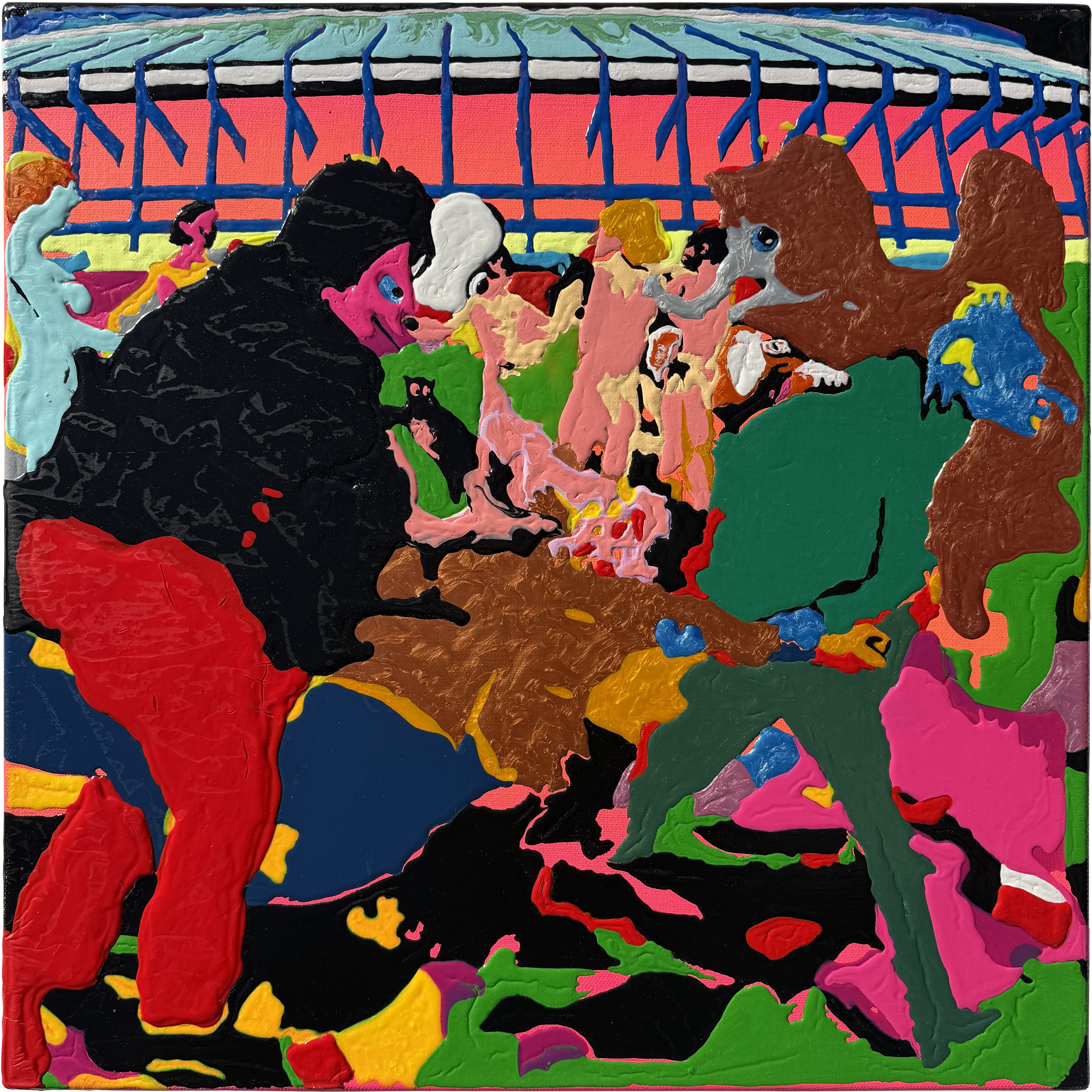
Parking Lot presents not a depiction of a specific historical event, but a structural anticipation of a recurring condition. The painting does not document an incident; it maps a pattern. Its force lies in how it renders visible a mode of violence that emerges within spaces conventionally understood as benign, festive, and civilian.
The setting—a stadium parking lot modeled on Atlanta–Fulton County Stadium but generalized to an archetypal American site—is central to the work’s logic. This is not a border zone, not a prison, not a battlefield. It is a transitional public space, designed for circulation, leisure, and mass gathering. Precisely because of this neutrality, it becomes the ideal stage for sudden coercion. The parking lot functions as a contemporary threshold where bodies are exposed, distracted, and unsuspecting, and where authority can assert itself without warning.
At the center of the composition, a figure is dragged away by others whose status remains deliberately ambiguous. These figures evoke agents of law or undercover enforcement, yet they are stripped of clear insignia or individuality. Rendered as semi-animal, semi-mechanical forms, they appear less as people than as instruments. Their cynicism is embedded in their opacity. They do not persuade, explain, or justify; they extract. The victim’s face is violently deformed, no longer readable as a stable identity. This distortion operates as a visual analogue to narrative violence—the moment at which a person is no longer legible as a civilian subject and is forcibly rewritten as a threat, a suspect, or an absence.
Behind this act unfolds a seemingly contradictory scene. Naked and half-naked figures dance in loose circles, suspended between protest and celebration, intoxication and obliviousness. They are not positioned as moral counterpoints to the violence, nor as its witnesses. They are the crowd. Their presence insists that collective pleasure, spectacle, and outrage can coexist with disappearance. The painting refuses the assumption that violence requires silence or secrecy. Instead, it suggests that violence today thrives amid noise, distraction, and sensory overload.
Color plays a critical role in this refusal. The palette is aggressively festive—psychedelic pinks, greens, blues, and blacks—producing an atmosphere closer to carnival than catastrophe. This visual excess is not ironic decoration. It articulates how repression now operates inside saturation: media churn, spectacle, and constant stimulation. Horror is not hidden; it is embedded within pleasure.
Parking Lot rejects the traditional iconography of oppression. There is no darkness, no alleyway, no covert raid. Everything unfolds in daylight, in public, amid bodies and color. The terror of the scene lies precisely in this openness. The central figure is not targeted because he is isolated, but despite being visible, surrounded, and exposed.
Ultimately, the painting is less concerned with a singular act of brutality than with a broader social condition—what might be described as arbitrary extraction. Bodies are removed, detained, neutralized, or erased from spaces designed for togetherness, consumption, and enjoyment. The parking lot becomes a contemporary agora where sovereignty reasserts itself abruptly and without warning.
If Parking Lot appears newly urgent, it is not because its meaning has shifted, but because the world has moved closer to the structure it identified. The painting’s prescience lies in its diagnosis of a condition whose contours have since intensified, making visible what was already latent in the everyday architecture of public life.