
CONSUMED BODIES
PAPER CUTOUTS
2021-2024
4.9 x 6.3 inches (12.5 x16 cm)

< >

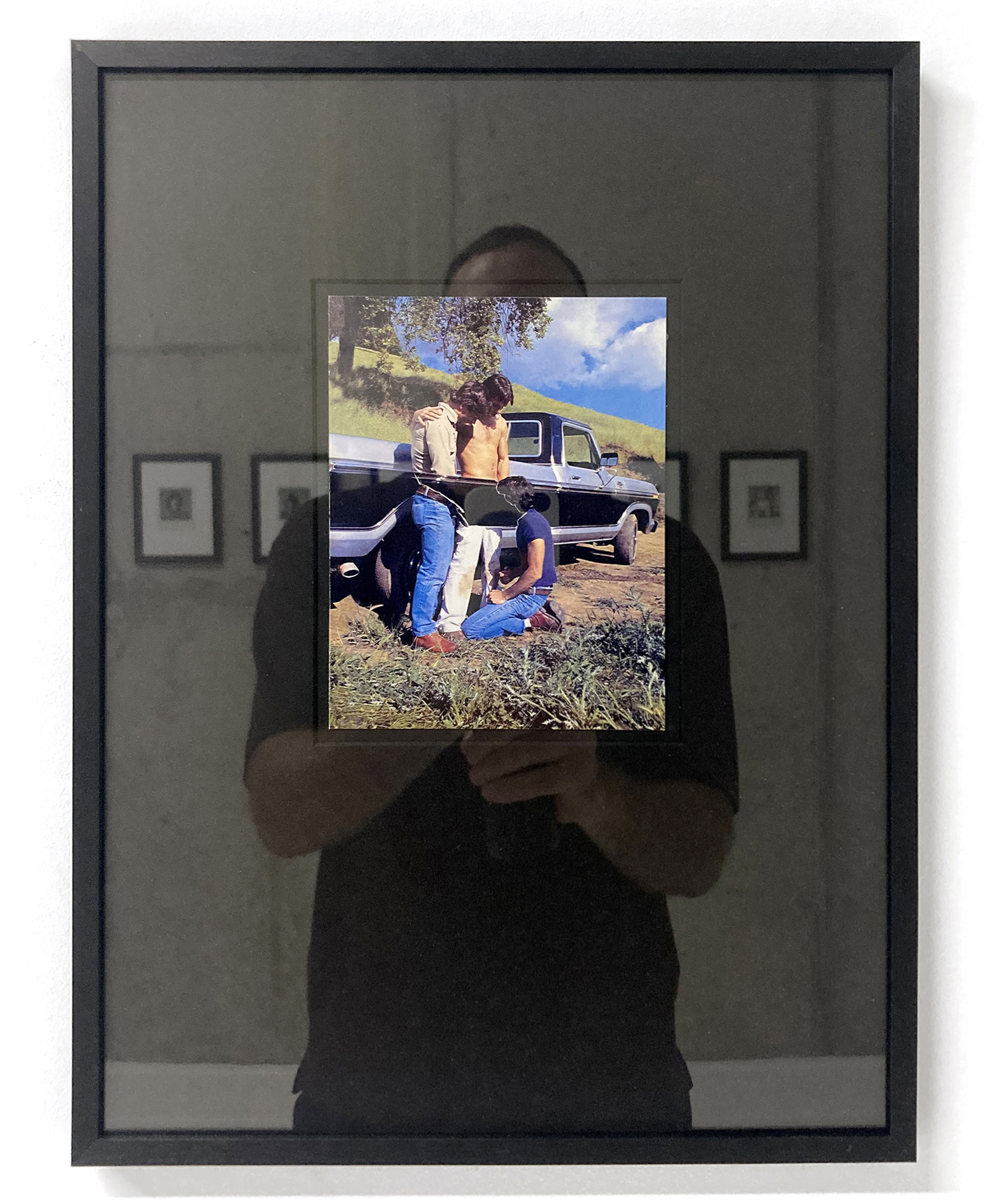
The cutouts begin with what might be called an absence, though it is given the formal dignity of a hole. A man—borrowed from the visual archive of pre-AIDS pornography—is removed from the page with care, leaving behind a contour that reads less as loss than as intention. Nothing is added. The usual consolations of collage, its layering and accumulation, are refused. Instead, the body is taken away and then returned in a diminished form, as though the work were testing how little of it needs to remain.

This is not montage so much as a procedure, repeated with a steadiness that borders on insistence. Cutting becomes an action that repeats itself without progress. The figure is broken apart and put back together, not in order to clarify meaning, but to thin it out, to see how far it can be reduced. What emerges is a system in which pleasure does not culminate but circulates, orbiting an empty centre. Desire is not fulfilled; it is rehearsed.

The viewer is drawn into this economy almost inadvertently. Looking becomes an act tied to something it cannot complete. What appears are not bodies in any conventional sense, but impressions of bodies—spaces where something once was. The images are constructed from absence, their substance a kind of disappearance. They seem less concerned with being seen than with slipping out of view. Pleasure enters quietly here, not as climax but as erosion. The fantasy offered is not self-realisation, but relief from having to be one.

The hole is therefore not merely a formal device. It operates as the work’s organising principle, a visual analogue for a deeper compulsion: not toward vitality, but toward undoing. These cutouts sit between repetition and erasure, suggesting that beneath the act of looking lies a wish for looking to fail—for meaning to give way to sensation, and for the image to confront the viewer emptied of depth.

And yet the hole is never inert. It carries a charge, a faint invitation. It is where private fantasy and inherited imagery intersect, where past pleasures brush against the projections of the present. The works do not grieve the bodies they invoke. They let them drift, fragment, recur. They insist on a small, disquieting truth: that to be reduced is not always to be diminished. Sometimes it is simply to occupy space differently.

What results is a choreography of absence. There is no resolution on offer, only a continuous circling of the void that produced the image in the first place. The pleasure returns to its origin repeatedly, knowing it will never quite arrive. In this sense, the cutouts rehearse a familiar human tension—the desire to disappear, held in uneasy balance with the need to remain visible.