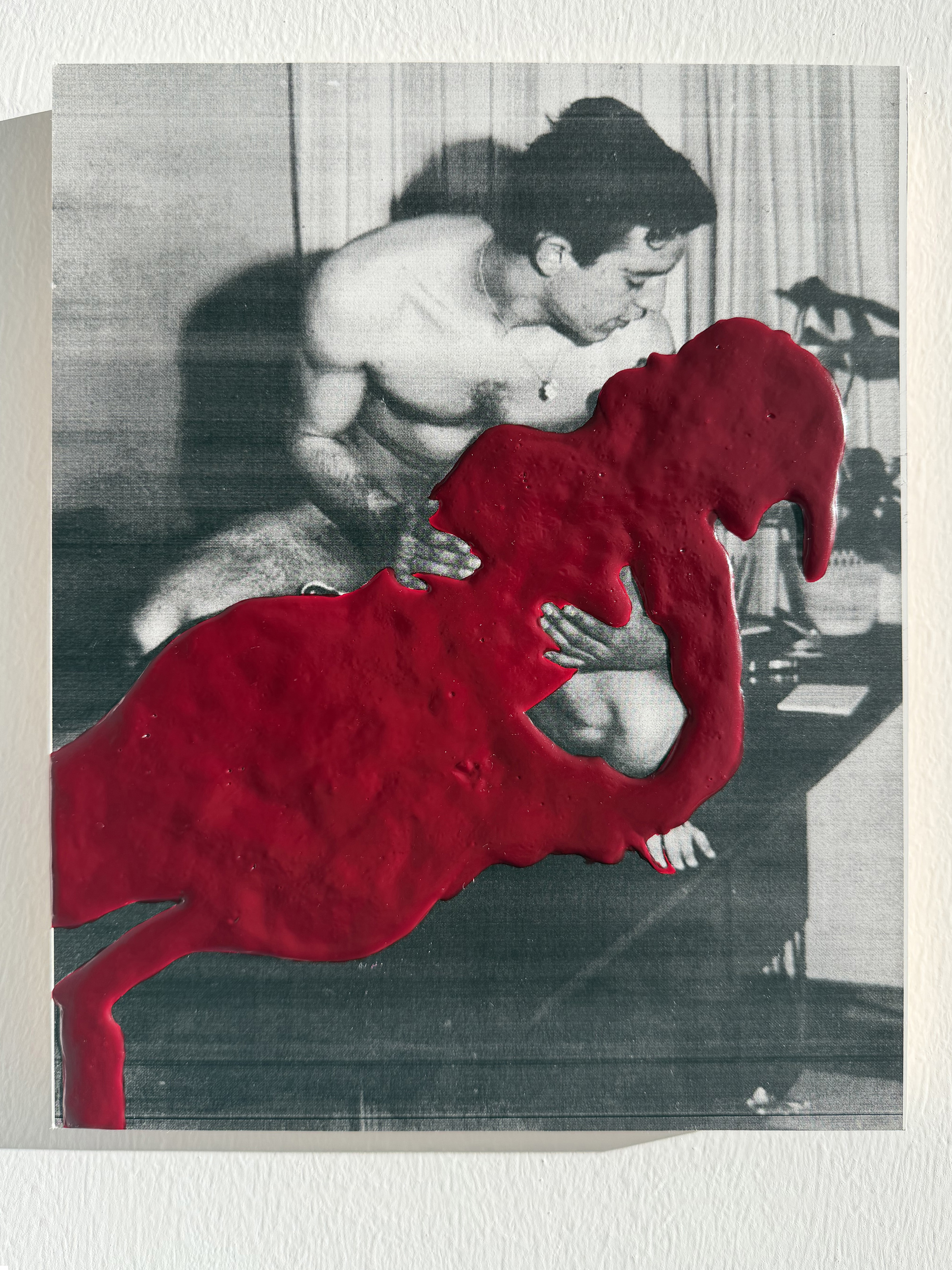
Funny Shoes, 2026,
an A4 laser print
and acrylic on board,
11 × 14 inches
(27.9 x 35.6 cm)

< >

Funny Shoes (2026) begins with the kind of image that is not supposed to last: a black-and-white laser print, thin as an excuse, already failing at its job. The photograph shows a shirtless man seated in a domestic interior—bed, sofa, the ambiguous furniture of private life—his head dipped as if to inspect his own gravity. The erotic charge is immediate, and also cheap in the way the erotic is cheap: skin offered without ceremony, the body presented as fact. It has the quiet confidence of pornography before it remembers it is pornography.

Then the printer gives up. Lines run through the image, the mild, bureaucratic violence of a budget machine insisting on its presence. The body is banded and dragged into the visual language of circulation: newsprint, photocopy, something passed around and half-forgotten. The man becomes both intimate and public, as if desire itself were a document that can be reproduced until it no longer contains the person who generated it.

Over this compromised intimacy, a red figure is applied. Not painted—applied, as one applies a patch, a sanction, a correction. The colour is not “red” in the decorative sense. It is butcher red: meat red, blood red, the red that looks wet even when it is dry. The surface is glossy and uneven, with pooling and drag that records the hand’s impatience. The material has a physicality that refuses interpretation. It does not want to be read; it wants to sit there.

The form is a kind of person, if one’s idea of a person comes from warnings. A rounded head with punched-out eyes; a torso; hands planted on hips in the posture of someone who has arrived to take charge of your private life. Legs splay out with an air of certainty and end in pointed shoes that are, frankly, ridiculous. They are the work’s small act of sabotage: the detail that prevents dignity from settling in. The shoes insist on comedy at the moment the viewer would prefer seriousness, which is to say they behave like truth.

The red figure covers the man’s torso and lap with the calm thoroughness of an official gesture. If the photograph offers sex, the overlay offers management. It blocks the genitals and simultaneously draws attention to them, performing the familiar trick of prohibition: the more emphatic the covering, the more insistent the thing beneath it becomes. Desire is not cancelled here; it is made administrative.

What the work understands—quietly, irritatingly well—is that the domestic scene is where everything becomes morally complicated. A bed is both a place of comfort and a place where the body is most available to being redefined. The photograph says: this is private. The overlay says: private is merely a category waiting to be revised. The intimacy is not between two people but between an image and the thing that has been forced onto it, as if grief and pornography have discovered they share a room.

The composition unfolds with the logic of delayed comprehension. You notice the surface defects first, then the body, then the covering, then—almost as an afterthought—the eyes cut into the red head, peering out like a witness who is also a censor. The viewer is led, step by step, into discomfort, not by spectacle but by accumulation. It is less a shock than a slow instruction in what you are willing to look at and what you are willing to call “normal.”

And this is the work’s most pointed joke: nothing dramatic is happening. There is no action, only aftermath. The photograph sits there like an old habit. The red form sits there like a consequence. The shoes sit there like a punchline. The viewer, meanwhile, performs the ritual that keeps daily life intact: looking long enough to feel implicated, then leaving with the relief that this, too, can be filed under an image. Everyone is either back to ordinary life or no longer available for comment. Order resumes. The printer lines remain.

In Funny Shoes, sex does not meet grief in a blaze of revelation. It meets it the way it usually does: in a room, on a surface, under a layer of something thick, red, and difficult to wash off. The work refuses the comfort of symbolism while happily exploiting the comfort of composition. It is intimate, because it is domestic; it is brutal, because it is banal; it is funny, because it knows the worst part is not what happened, but the fact that we are still able to watch it and then go on.