
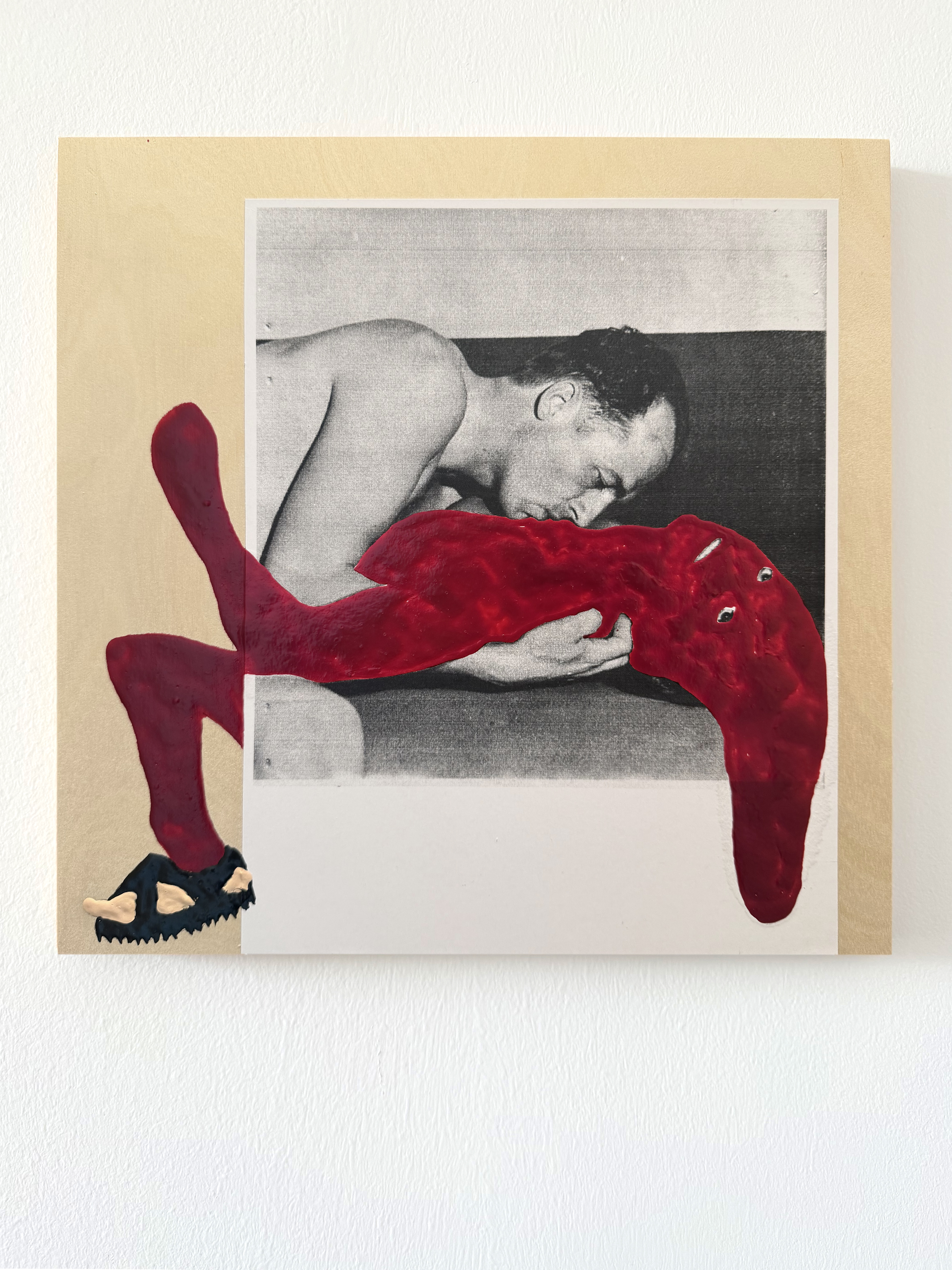
The One Sandal works differently from Funny Shoes and Engagement Ring. It reintroduces awkwardness after the relative gravity of Engagement Ring, but it does so in a way that feels intentional rather than evasive.
What’s immediately striking is that the red form has regained a kind of mobility. It stretches laterally across the image, bridging the photographic body and the board’s edge. It no longer reads as something simply borne or held; it behaves like something that is half-leaving, half-attached. The gesture is transitional rather than resolved. The reappearance of the shoe—now singular—matters. Unlike the earlier Funny Shoes, this one is not symmetrical, not balanced, not even properly paired. The lone sandal introduces incompleteness rather than comedy. It looks provisional, leftover, or mislaid. It is not footwear as identity; it is footwear as evidence. Erotically, the image is quieter than Funny Shoes but more uneasy.
The man’s posture remains intimate and inward, but the red form no longer blocks so much as slides past the sexual centre. Desire here is not confronted or burdened; it is displaced. The red mass does not settle. It passes through. Materially, the red retains its meat-like viscosity—glossy, dense, faintly unpleasant—but its behavior is less inert. It stretches, thins, and tapers. This makes it feel less like a body and more like a remnant in motion, something that hasn’t decided whether it belongs, like a cat stretching and struggling to get down, searching for the floor. The domestic scene remains banal, almost stubbornly so. That banality does a lot of work. Nothing in the setting reacts to what is happening. The room does not care. This keeps the image from tipping into allegory. If Funny Shoes was about misrecognition and Engagement Ring was about commitment and burden, then this one is about imbalance and remainder. It’s a good progression.
The title is radically under-informative. “The One Sandal” sounds almost stupid. It points to a detail without explaining why it matters. It introduces asymmetry without metaphor. One sandal implies loss, haste, interruption, or survival—but the title doesn’t say any of that. It lets the viewer arrive there, or not. It shifts the register from obligation to residue. An engagement ring implies a system. A single sandal implies aftermath. Something has already happened; we’re not told what. It’s dry enough to be funny without trying. There’s a faint echo of bureaucratic or biblical phrasing (“the one…”), but it never declares itself. A sandal could be overdetermined historically or culturally, but the title keeps it literal. It names what is there and stops.