
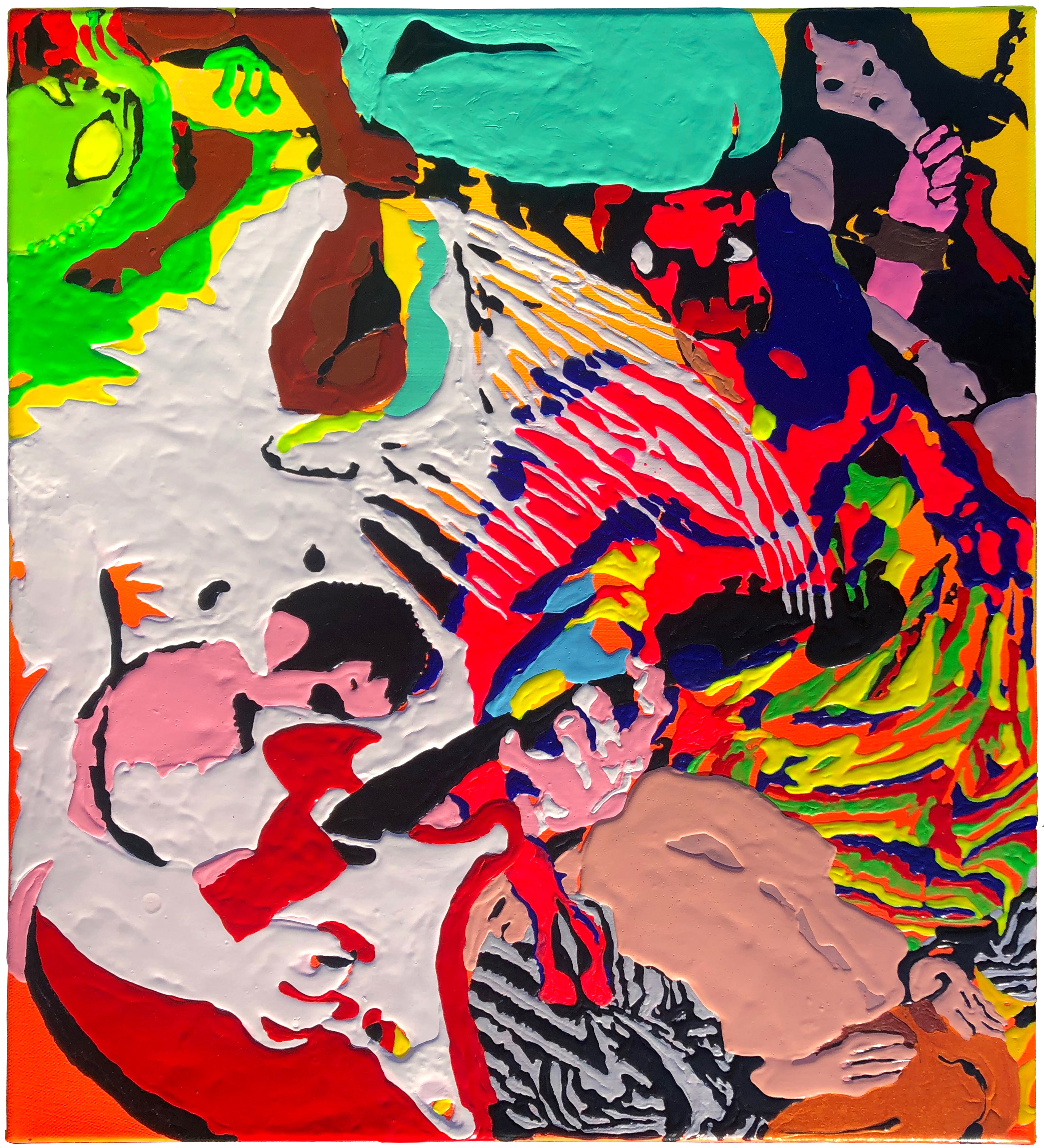
This painting confronts Holocaust memory not through historical illustration, but through psychic distortion and visual overload. It begins from a specific historical source: a drawing made after the war, in the late 1940s, depicting the liquidation of the Jewish ghetto in Będzin, Upper Silesia, in August 1943. In early August 1943, German forces carried out the final destruction of the Będzin Jewish community as part of the process of making the area Judenrein. Jews were violently expelled from their homes, families were torn apart, bodies were dragged through the streets, and the remaining population was deported to Auschwitz-Birkenau, where most were murdered.
The original drawing was made by Ella Lieberman-Scheiber, a survivor of the Będzin Ghetto who witnessed these events firsthand. She experienced the liquidation, deportation, and camps directly, and survived in part because of her artistic talent, which the Nazis exploited by employing her as a portrait painter. In the years following her liberation, she produced a series of drawings that record the horrors she had seen—works made not from imagination, but from lived experience.
Lieberman-Scheiber’s drawing renders the violence with narrative clarity: a pointing soldier, civilians fleeing, bodies being carried away, authority exercised openly and efficiently. My painting begins where that clarity collapses.
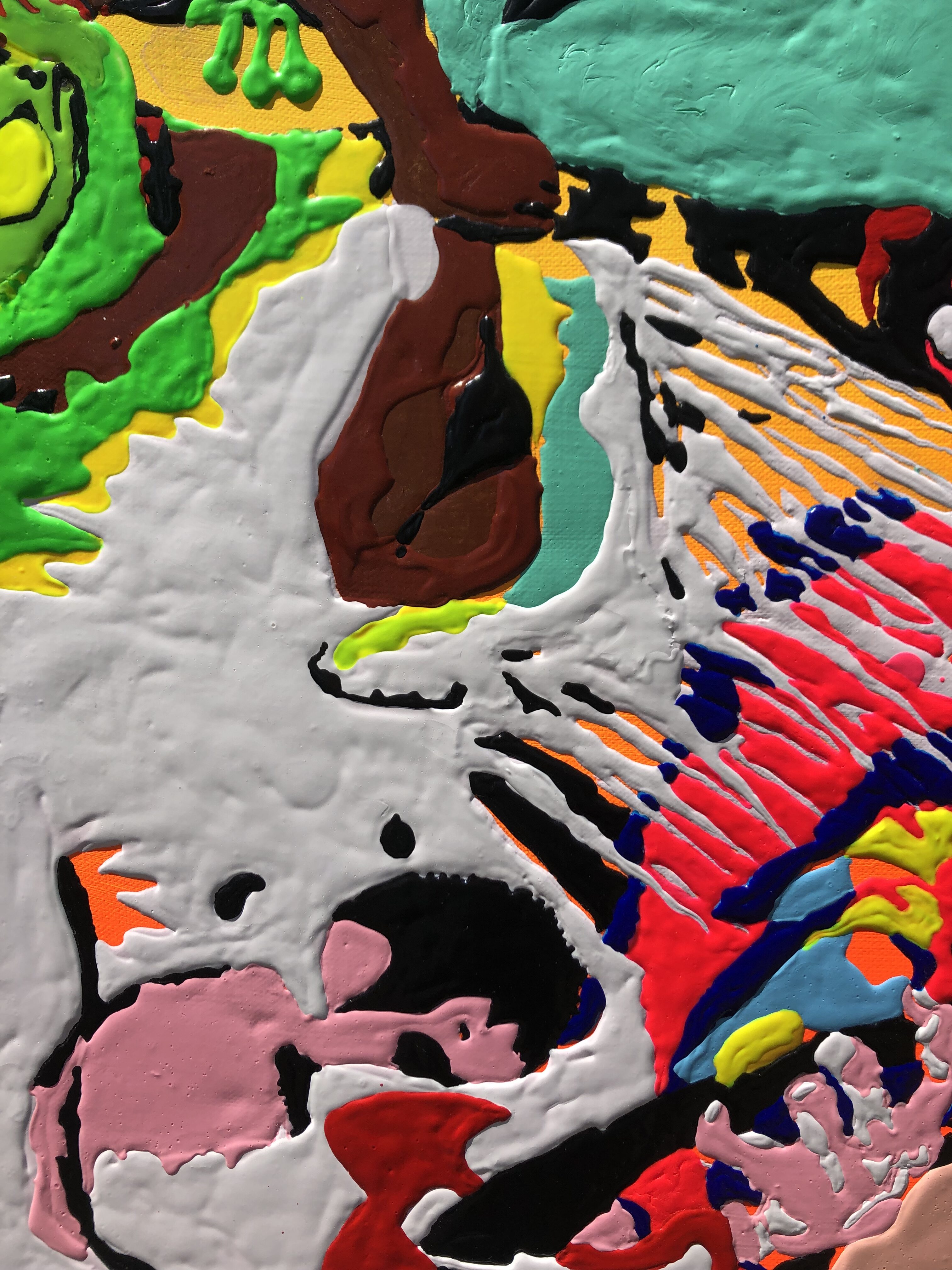
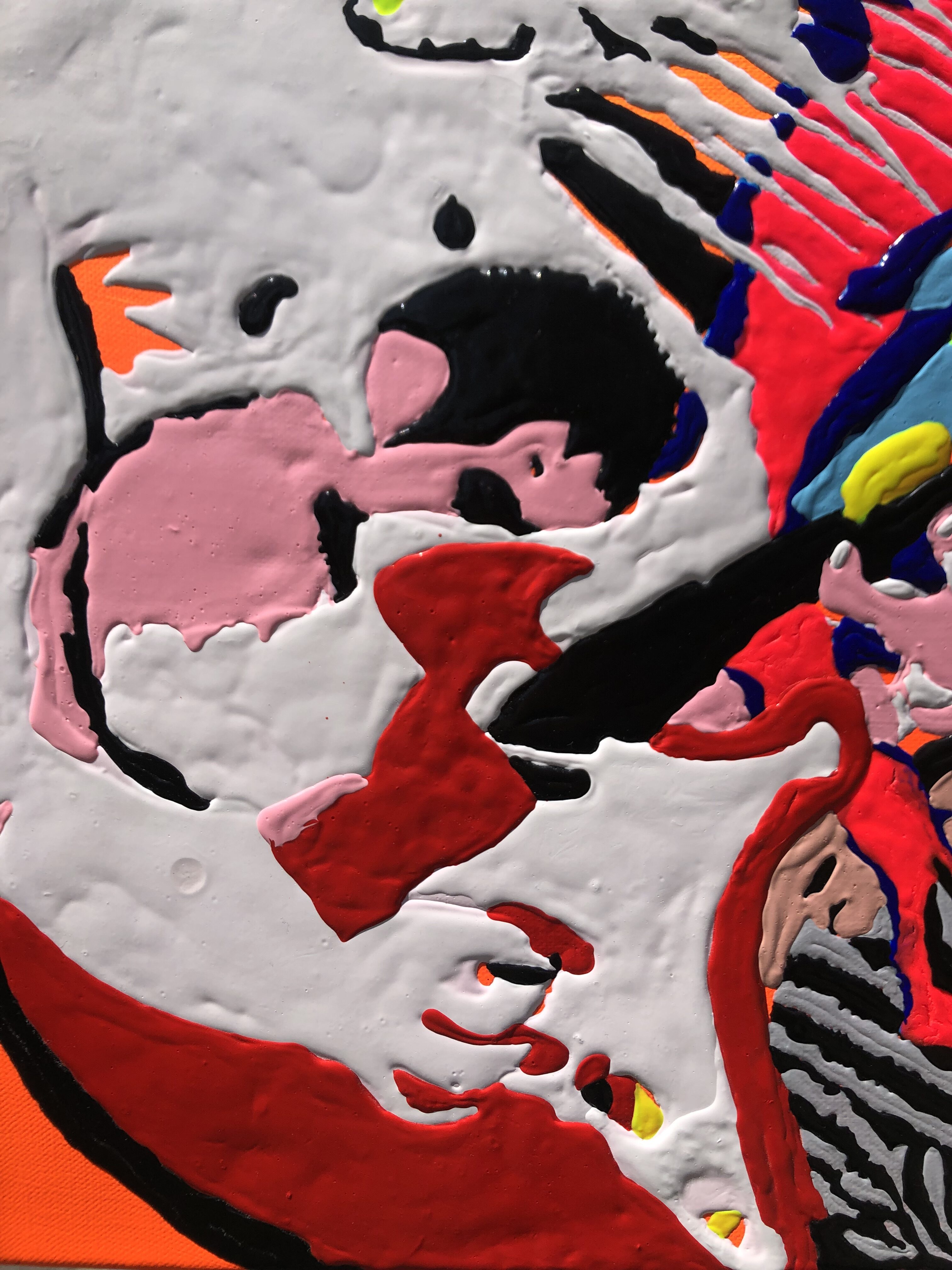
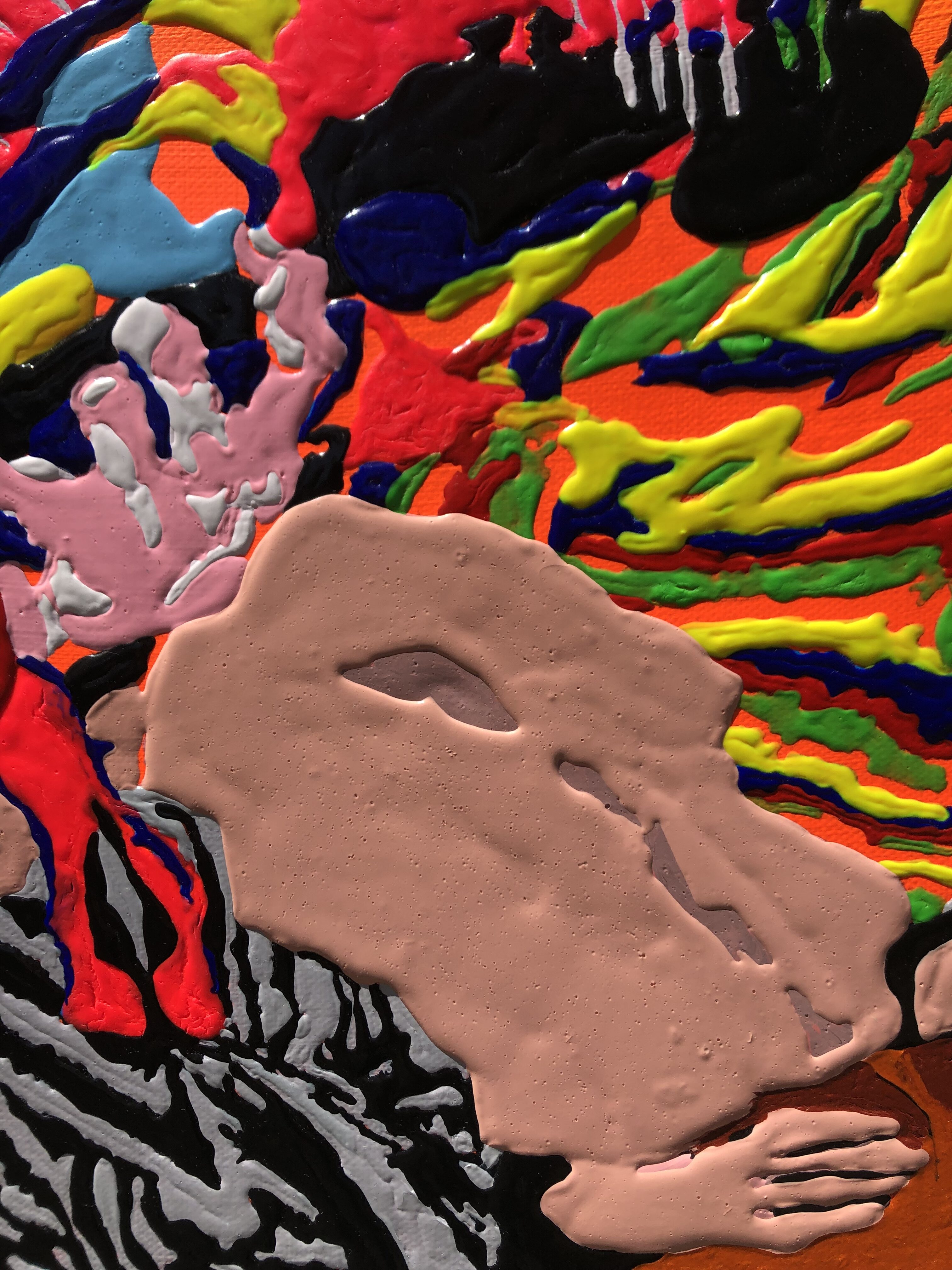
Here, the Holocaust is not represented as a past event, but as a condition embedded in thought, perception, and everyday psychic life. Figures do not fully cohere; bodies fragment, faces slip, limbs dissolve into paint. This instability is deliberate. It reflects how historical terror survives not as stable memory, but as pressure, noise, and internal distortion—something lodged in the psyche and carried forward across time.
At the top right of the painting is a dead Jewish girl being carried away by her brother. This image directly transposes Lieberman-Scheiber’s drawing, in which a young girl’s body is removed during the liquidation of the ghetto—not as an act of execution, but as part of an administrative process of erasure. The violence here is intimate and bureaucratic at once. The brother’s role is forced; he becomes an unwilling participant in the annihilation of his own world. In the painting, this scene is partially submerged beneath layers of color and material, as if memory itself is trying—and failing—to bury what cannot be metabolized.
In the bottom right corner lies a dead concentration-camp prisoner. His hands are bound behind his back; the striped uniform marks him unmistakably as an inmate. Yet the black-and-white stripes dissolve into saturated, multicolored bands. These stripes deliberately invoke Joseph’s multicolored coat—a biblical symbol of chosenness, survival, and narrative meaning—now violently inverted. Color does not redeem the body; it overwhelms it. Promise collapses into excess and spectacle.
Running through this nightmare is a large, central, white, ghost-like figure—part apparition, part electric guitar player. This figure represents energy, youth, and continuation. It is not innocence and not redemption. It is the stubborn persistence of life itself: rhythm, vibration, movement that continues despite everything. The figure is spectral because this continuity is haunted; it exists alongside catastrophe, not after it. Music functions here not as harmony, but as force—feedback, distortion, survival through volume. At the center of the guitar playing figure we can see the head and torso of the young brother drowning inside the ghost in such a way that it appears as if he is playing the guitar but his head is downwards melancholic sad
The glossy, hyper-saturated surface draws from the visual language of electric-guitar culture, horror monsters, psychedelia, and escapist spectacle. This is not escapism as denial, but escapism as compulsion: the desperate attempt to outrun embedded memory through sensation, excess, and noise. The paint behaves like feedback—screaming rather than speaking—seducing the eye while refusing comfort.
The sharp juxtaposition between seductive color and historical terror is central to the work. The Holocaust is not sealed in the past; it persists in the psyche, erupting unpredictably, often disguised by pleasure, culture, and distraction. The painting stages this contradiction: the impossibility of escape, and the equally powerful drive to keep living anyway.
Nothing in the painting resolves. There is no moral closure, no redemptive abstraction. Figures remain trapped within the paint, just as history remains lodged within contemporary consciousness. What appears psychedelic is also claustrophobic. What appears energetic is inseparable from trauma.
This work is not about remembering the Holocaust correctly. It is about living with it incorrectly, compulsively, and permanently—where horror, youth, noise, color, and survival coexist without reconciliation.